- 8 sights
- 2 h 30 min
- 12.45 km / 7.74 mi

Sights
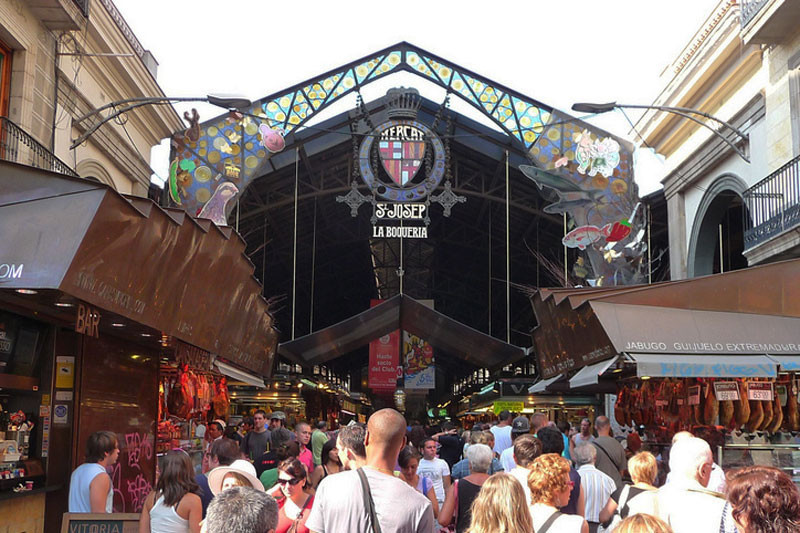
Mercado de La Boqueria
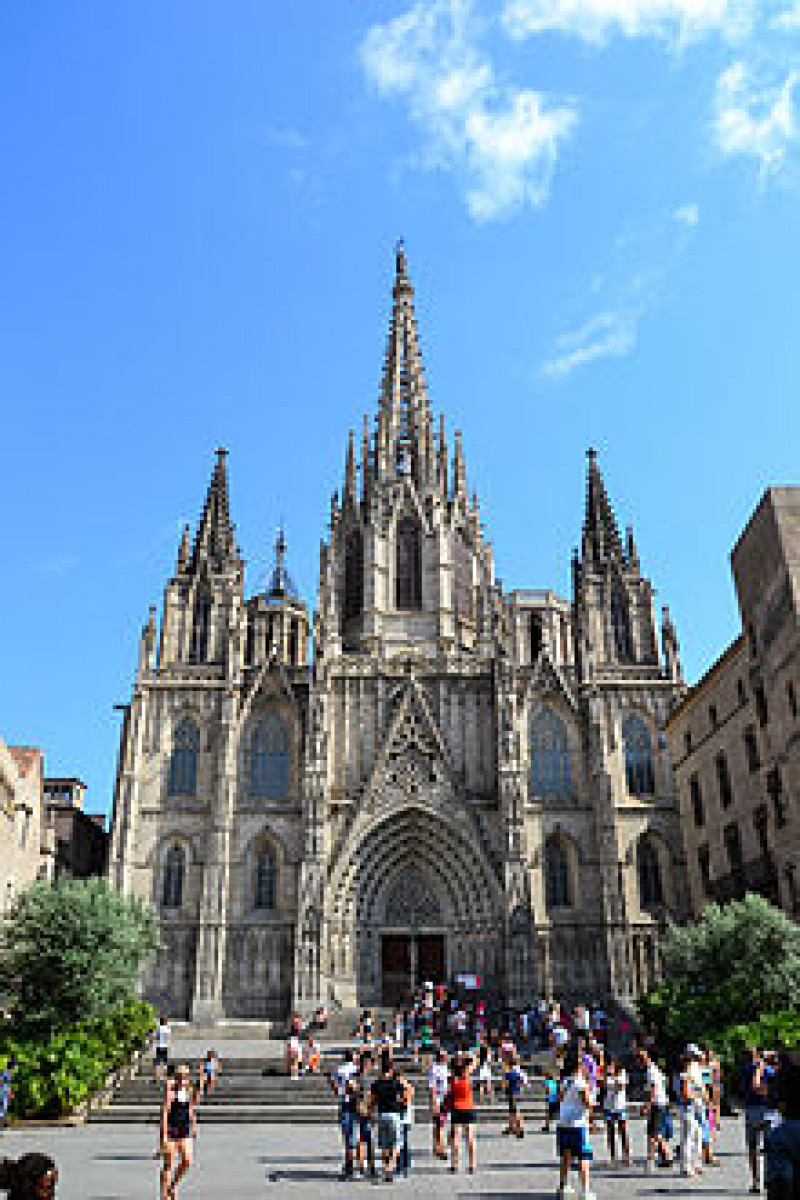
Cathedral of Barcelona
Not to be confused with Sagrada Família, which is a large church by Antoni Gaudí, also in Barcelona The Cathedral of the Holy Cross and Saint Eulalia (Catalan: Catedral de la Santa Creu i Santa Eulàlia, Spanish: Catedral de la Santa Cruz y Santa Eulalia), also known as Barcelona Cathedral, is the Gothic cathedral and seat of the Archbishop of Barcelona, Spain. The cathedral was constructed from the 13th to 15th centuries, with the principal work done in the 14th century. The cloister, which encloses the Well of the Geese (Font de les Oques) was completed in 1448. In the late 19th century, the neo-Gothic façade was constructed over the nondescript exterior that was common to Catalan churches. The roof is notable for its gargoyles, featuring a wide range of animals, both domestic and mythical. It is a pseudobasilica, vaulted over five aisles, the outer two divided into chapels. The transept is truncated. The east end is a chevet of nine radiating chapels connected by an ambulatory. The high altar is raised, allowing a clear view into the crypt. The cathedral is dedicated to Eulalia of Barcelona, co-patron saint of Barcelona, a young virgin who, according to Catholic tradition, suffered martyrdom during Roman times in the city. One story says that she was exposed naked in the public square and a miraculous snowfall in mid-spring covered her nudity. The enraged Romans put her into a barrel with knives stuck into it and rolled it down a street (according to tradition, the one now called Baixada de Santa Eulàlia). The body of Saint Eulalia is entombed in the cathedral's crypt. The choir stalls retain the coats-of-arms of the knights of the Order of the Golden Fleece. In his first trip into Spain, Charles, the future Holy Roman Emperor, selected Barcelona as the site of a chapter of his Order. The king had arrived for his investiture as Count of Barcelona, and the city, as a Mediterranean port, offered the closest communication with other far-flung Habsburg dominions, while the large proportions of the cathedral would accommodate required grand ceremonies. In 1518 the Order's herald, Thomas Isaac, and its treasurer, Jean Micault, were commissioned to prepare the sanctuary for the first sitting of the chapter in 1519. Juan de Borgonya executed the painted decoration of the sanctuary. "The church was named after Barcelona's patron saint Eulalia; its official name - Catedral de la Santa Creu i Santa Eulalia - is Catalan for "Cathedral of the Holy Cross and Saint Eulalia". The commonly used name La Seu refers to the status of the church as the seat of the diocese." The side Chapel of the Holy Sacrament and of the Holy Christ of Lepanto contains a cross said to date from the time of the Battle of Lepanto (1571). In addition to Saints Eulàlia and Olegarius, the cathedral contains the tombs of Saint Raymond of Penyafort, Count Ramon Berenguer I and his third wife Almodis de la Marche, and bishops Berenguer de Palou II, Salvador Casañas y Pagés, and Arnau de Gurb, who is buried in the Chapel of Santa Llúcia, which he had constructed. The cathedral has a secluded Gothic cloister where 13 white geese are kept, the number explained by the assertion that Eulalia was 13 when she was martyred. A program of cleaning and restoration of the cathedral was carried out from 1968-72.

Parc de la Ciutadella
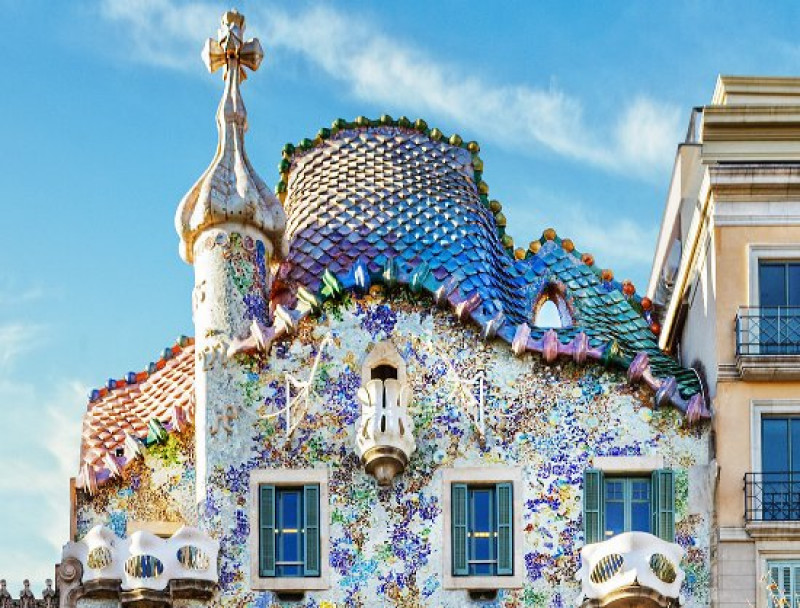
Casa Batlló
Casa Batlló (Catalan pronunciation: [ˈkazə βəˈʎːo]) is a renowned building located in the center of Barcelona and is one of Antoni Gaudí’s masterpieces. A remodel of a previously built house, it was redesigned in 1904 by Gaudí and has been refurbished several times after that. Gaudí's assistants Domènec Sugrañes i Gras, Josep Canaleta and Joan Rubió also contributed to the renovation project. The local name for the building is Casa dels ossos (House of Bones), as it has a visceral, skeletal organic quality. Like everything Gaudí designed, it is only identifiable as Modernisme or Art Nouveau in the broadest sense. The ground floor, in particular, has unusual tracery, irregular oval windows and flowing sculpted stone work. There are few straight lines, and much of the façade is decorated with a colorful mosaic made of broken ceramic tiles (trencadís). The roof is arched and was likened to the back of a dragon or dinosaur. A common theory about the building is that the rounded feature to the left of centre, terminating at the top in a turret and cross, represents the lance of Saint George (patron saint of Catalonia, Gaudí's home), which has been plunged into the back of the dragon.
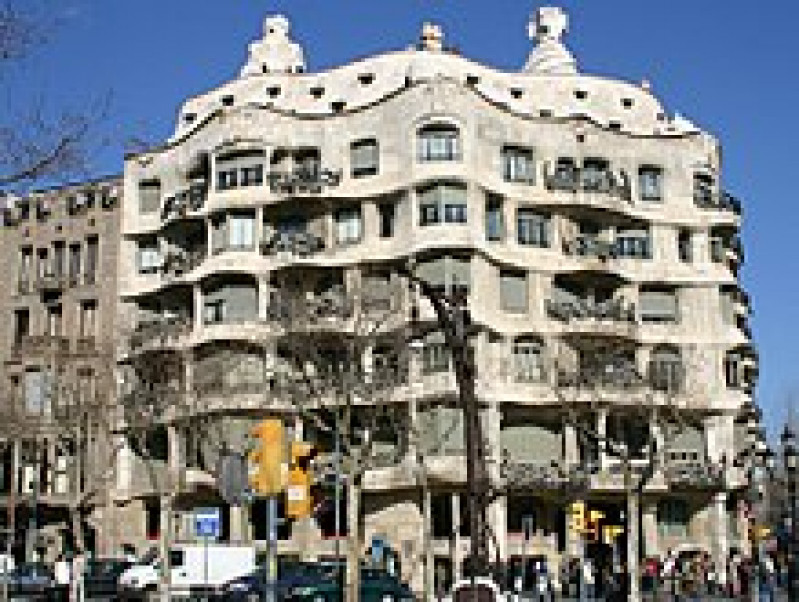
Casa Milà
Casa Milà (Catalan pronunciation: [ˈkazə miˈɫa], Spanish pronunciation: [ˈkasa miˈla]), popularly known as La Pedrera or "open quarry", a reference to its unconventional rough-hewn appearance, is a modernist building in Barcelona, Catalonia, Spain. It was the last private residence designed by architect Antoni Gaudí and was built between 1906 and 1912. The building was commissioned in 1906 by Pere Milà and his wife Roser Segimon. At the time, it was controversial because of its undulating stone facade, twisting wrought iron balconies and designed by Josep Maria Jujol. Several structural innovations include a self-supporting stone façade, and an free-plan floor, underground garage and the spectacular on the roof-terrace. In 1984, it was declared a World Heritage Site by UNESCO. From 2013 is the headquarters of the Fundació Catalunya La Pedrera which manages the visit to the building, exhibitions and other cultural and educative activities at Casa Milà.
Sagrada Família
Park Güell
Triumphal Arch
Share on Pinterest
