- 9 sights
- 1 h 09 min
- 5.69 km / 3.53 mi

Sights
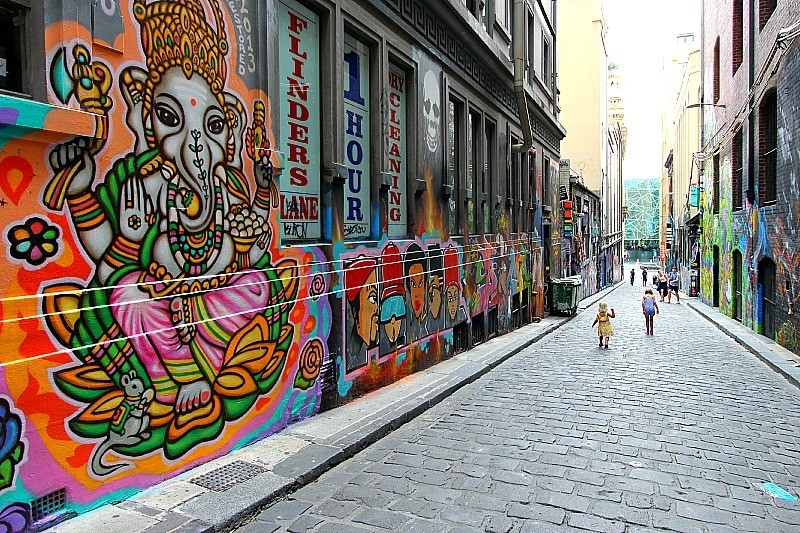
Hosier Lane
The lanes and arcades of Melbourne, Australia, have collectively become culturally important. The Melbourne central business district's numerous lanes mostly date to the Victorian era and as a result of the original Hoddle Grid, they evolved as service laneways for horses and carts. In some parts of the city, notably Little Lonsdale area, they were associated with the city's gold rush era slums. Among the most notable are Centre Place and Degraves Lane. Melbourne's numerous shopping arcades reached a peak of popularity in the late Victorian era and the interwar years. Among the most notable include Block Place and Royal Arcade. Some notable demolished arcades include Coles Book arcade and Queens Walk arcade. Since the 1990s, Melbourne's lanes, particularly the pedestrianised ones, have gentrified and their heritage value officially recognised as well as attracting interest from Australia and around the world. Some of the lanes, in particular have become particularly notable for their acclaimed urban art. The city has several festivals which celebrate the laneways, they are major tourist attractions and frequently feature in tourism promotions, film and television.
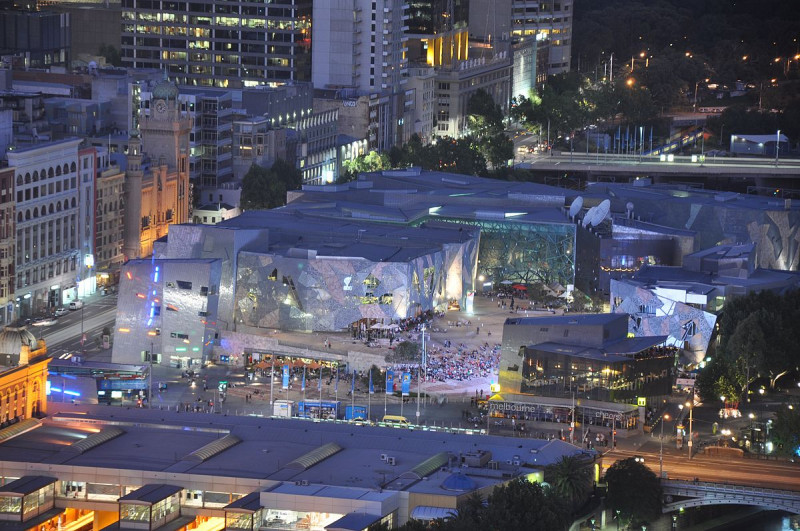
Federation Square
Federation Square is a mixed-use development in the inner city of Melbourne, covering an area of 3.2 ha (7.9 acres) and centred on three major public spaces – St. Paul's Court, The Square, and The Atrium. Built on a concrete deck above busy railway lines, it is located at the intersection of Flinders Street and Swanston Street/St Kilda Road in the city's central business district, adjacent to Flinders Street station.
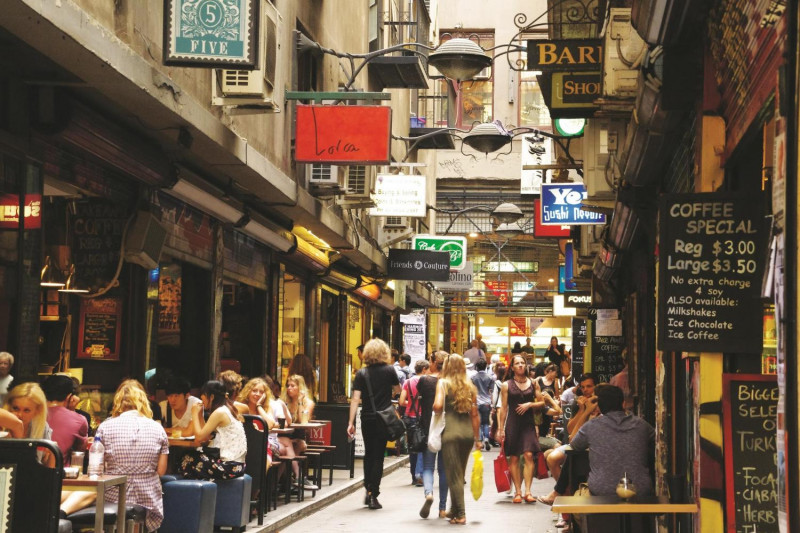
Degraves Lane
Degraves Street is a pedestrian precinct and thoroughfare in Melbourne, Australia. It is a short, narrow laneway in the Central Business District that runs north-south from Flinders Street to Flinders Lane and is situated in-between Swanston Street and Elizabeth Street. Degraves, as the street is colloquially known, is famous for its alfresco dining options and because it epitomises Melbourne's famous coffee culture and street art scene. For these reasons it has also become a popular tourist destination. The street is named after Charles and William Degraves, pioneer merchants from Hobart who built a flour mill at the corner of Flinders Lane and Degraves Street in 1849. William was also notably a member of the Victorian Legislative Council for fourteen years.
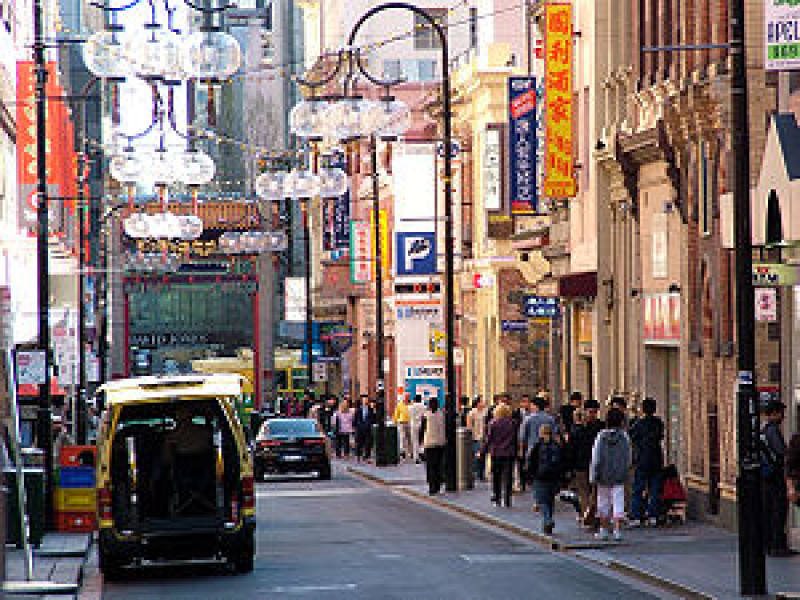
Little Bourke
Little Bourke Street (abbreviated to Lt. Bourke St) in Melbourne's CBD runs roughly east–west within the Hoddle Grid. It is a one-way street heading in a westward direction. The street intersects with Spencer Street at its western end and Spring Street at its eastern end. Melbourne's Chinatown, which extends between the corners of Swanston and Exhibition Streets, is a major feature of the street. Major department stores Myer and David Jones along with upscale shopping centre Emporium Melbourne have entrances on Little Bourke Street with stores Coach, Michael Kors, Ted Baker, Emporio Armani and Kate Spade New York within the centre having frontages onto Little Bourke between Swanston Street and Elizabeth Street. The back entrance of GPO Melbourne is also on this street. Higher-end restaurants are found on the stretch between Exhibition Street and Spring Street.
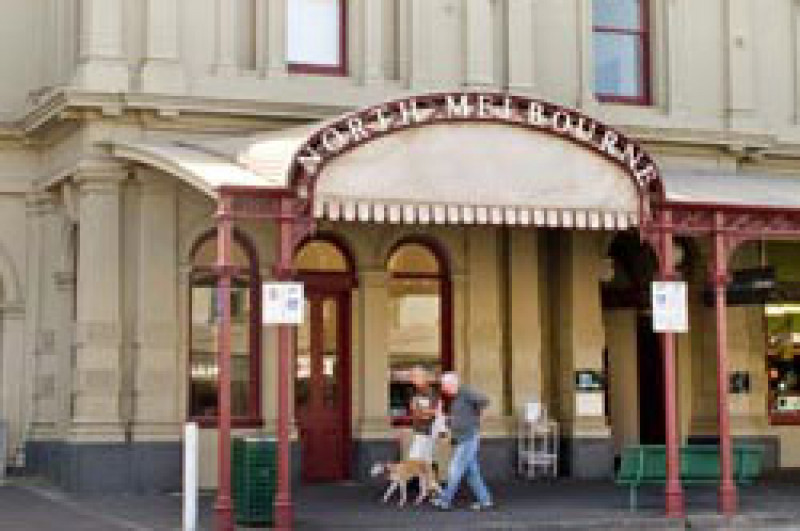
Melbourne Library
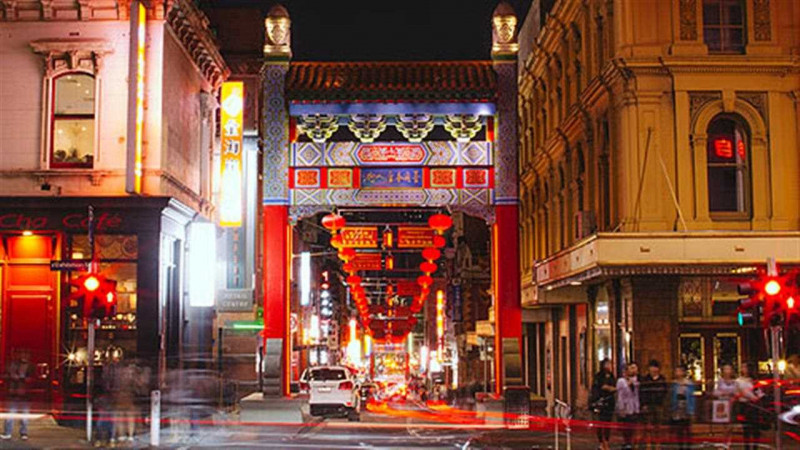
Chinatown
A Chinatown (Chinese: 唐人街; pinyin: Tángrénjiē; Jyutping: tong4 yan4 gaai1) is an ethnic enclave of Chinese or Han people located outside mainland China or Taiwan, most often in an urban setting. Areas known as "Chinatown" exist throughout the world, including Asia, Australia, the Americas, Africa and Europe. The development of most Chinatowns typically resulted from mass migration to an area without any, or with very few Chinese residents. Binondo in Manila, established in 1594, is recognised as the world's oldest Chinatown. Notable early examples outside Asia include San Francisco's Chinatown in the United States and Melbourne's Chinatown in Australia, which were founded in the mid-19th century during the California gold rush and Victoria gold rush respectively. A more modern example, in Montville, Connecticut, was caused by the displacement of Chinese workers in the Manhattan Chinatown following the September 11th attacks in 2001.
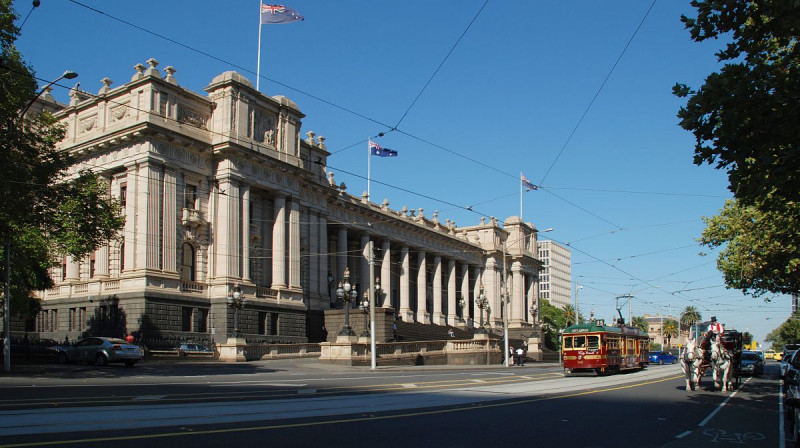
Parliament House
Parliament House, Melbourne was constructed between 1855 and 1929 and is located on Spring Street in East Melbourne, Victoria. It has served as both the seat of the Parliament of Victoria (1855–1901, 1927–present) and as the seat of the Federal Parliament of Australia (1901–27). The building is listed on the Victorian Heritage Register and celebrated its 150th anniversary in 2005–6.
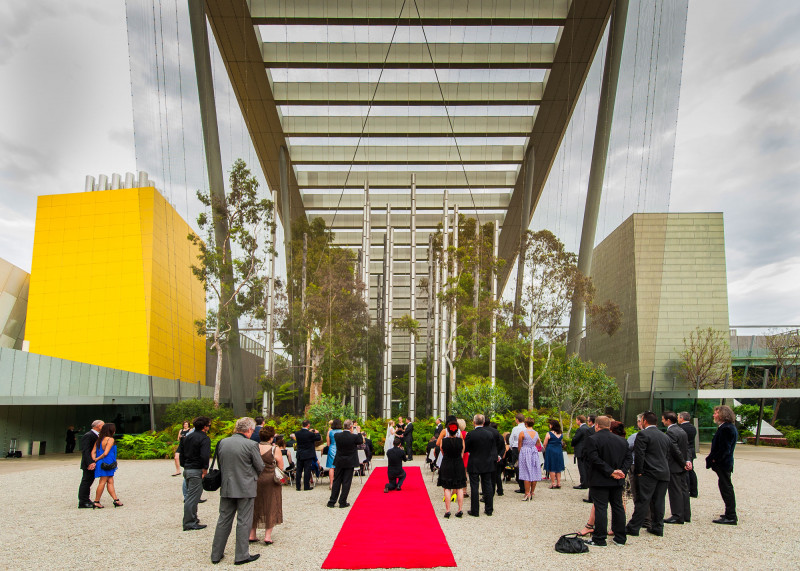
Melbourne Museum
Melbourne Museum is a natural and cultural history museum located in the Carlton Gardens in Melbourne, Australia. Located adjacent to the Royal Exhibition Building, it is the largest museum in the Southern Hemisphere. The museum was opened in 2000 as a project of the Government of Victoria, on behalf of Museums Victoria who administrates the venue. Melbourne museum is a rich response to Melbourne’s urban condition, and provides a place for education, history, culture and society to engage with each other in a contemporary setting. It is now an important part of Melbourne’s soft infrastructure and is consistently ranked as one of the most popular museums and tourist attractions in Australia, winning 'Best Tourist Attraction' at the Australian Tourism Awards in 2011. In addition to its galleries, the museum features spaces such as the Sidney Myer Amphitheatre and The Age Theatre, as well as the free Discovery Centre, a cafe and a souvenir shop. IMAX Theatre is also part of the museum complex, showing movies and documentary films in large-screen 3-D format.
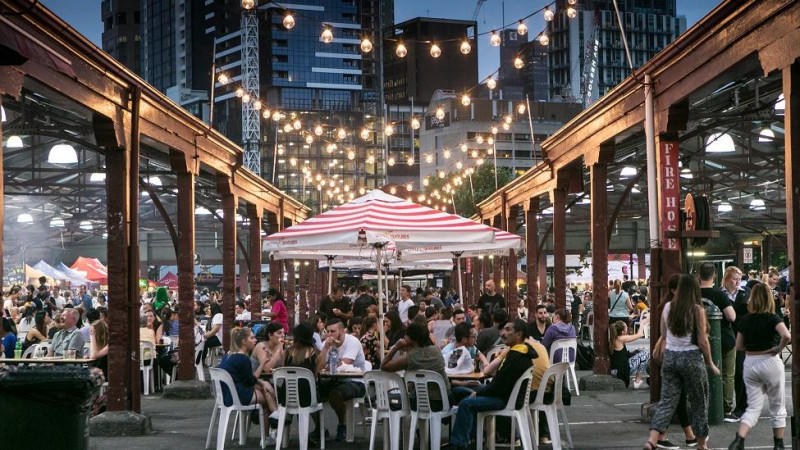
Queen Victoria Markets
The Queen Victoria Market (also known locally as Vic Market or Queen Vic) is a major landmark in Melbourne, Australia, and at around seven hectares (17 acres) is the largest open air market in the Southern Hemisphere. The Queen Victoria Market is the largest and most intact surviving 19th century market in the city. The Melbourne central business district once hosted three major markets, but two of them, the Eastern Market and Western Market, both opened before the Queen Victoria, and were both closed and demolished in the 1960s. Other historic markets survive in Melbourne, such as the inner suburban Prahran Market and South Melbourne Market, though only Prahran has any early buildings. The Queen Victoria Market is historically, architecturally and socially significant and has been listed on the Victorian Heritage Register. It has become an increasingly important tourist attraction in the city of Melbourne.
Share on Pinterest
