- 11 sights
- 1 h 37 min
- 8.09 km / 5.02 mi
Rome in one day
One day in Rome.
From www.worldwanderista.com/day-trip-rome-italy-walking-map/

published 9 years ago
Sights
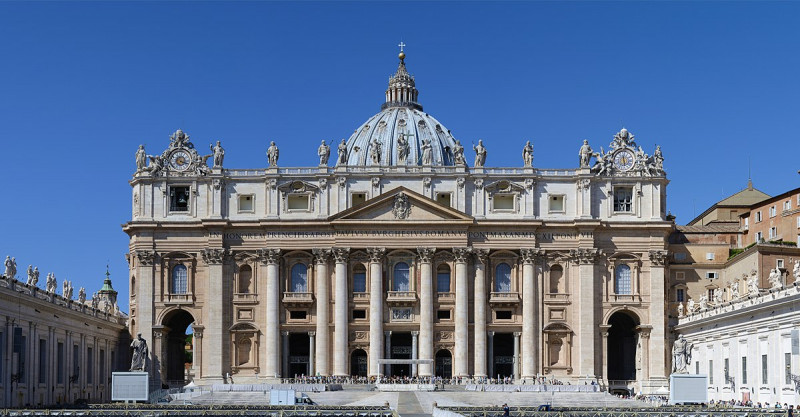
Saint Peter's Basilica
The Papal Basilica of St. Peter in the Vatican (Italian: Basilica Papale di San Pietro in Vaticano), or simply St. Peter's Basilica (Latin: Basilica Sancti Petri), is an Italian Renaissance church in Vatican City, the papal enclave within the city of Rome. Designed principally by Donato Bramante, Michelangelo, Carlo Maderno and Gian Lorenzo Bernini, St. Peter's is the most renowned work of Renaissance architecture and the largest church in the world. While it is neither the mother church of the Catholic Church nor the cathedral of the Diocese of Rome, St. Peter's is regarded as one of the holiest Catholic shrines. It has been described as "holding a unique position in the Christian world" and as "the greatest of all churches of Christendom". Catholic tradition holds that the Basilica is the burial site of Saint Peter, one of Jesus's Apostles and also the first Pope. Saint Peter's tomb is supposedly directly below the high altar of the Basilica. For this reason, many Popes have been interred at St. Peter's since the Early Christian period, and there has been a church on this site since the time of the Roman emperor Constantine the Great. Construction of the present basilica, which would replace Old St. Peter's Basilica from the 4th century AD, began on 18 April 1506 and was completed on 18 November 1626. St. Peter's is famous as a place of pilgrimage and for its liturgical functions. The Pope presides at a number of liturgies throughout the year, drawing audiences of 15,000 to over 80,000 people, either within the Basilica or the adjoining St. Peter's Square. St. Peter's has many historical associations, with the Early Christian Church, the Papacy, the Protestant Reformation and Catholic Counter-reformation and numerous artists, especially Michelangelo. As a work of architecture, it is regarded as the greatest building of its age. St. Peter's is one of the four churches in the world that hold the rank of Major Basilica, all four of which are in Rome. Contrary to popular misconception, it is not a cathedral because it is not the seat of a bishop; the Cathedra of the Pope as Bishop of Rome is in the Archbasilica of St. John Lateran.
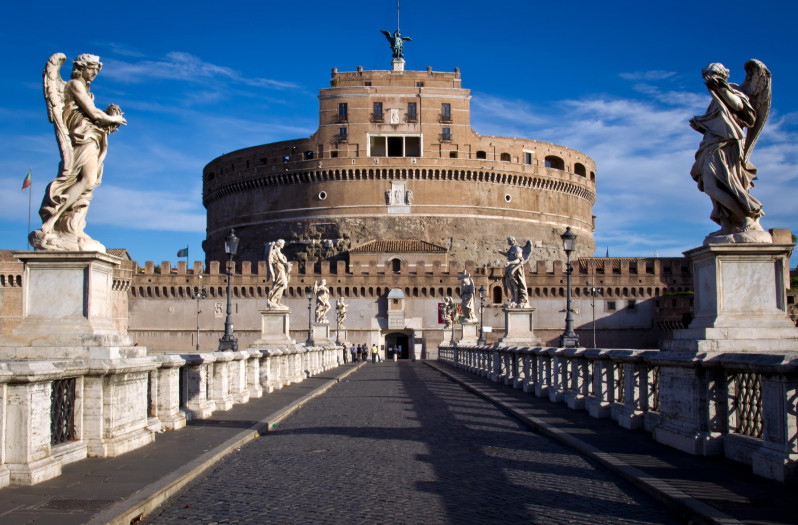
Castel Sant'Angelo
The Mausoleum of Hadrian, usually known as Castel Sant'Angelo (Italian pronunciation: [kaˈstɛl sanˈtandʒelo]; English: Castle of the Holy Angel), is a towering cylindrical building in Parco Adriano, Rome, Italy. It was initially commissioned by the Roman Emperor Hadrian as a mausoleum for himself and his family. The building was later used by the popes as a fortress and castle, and is now a museum. The Castle was once the tallest building in Rome.
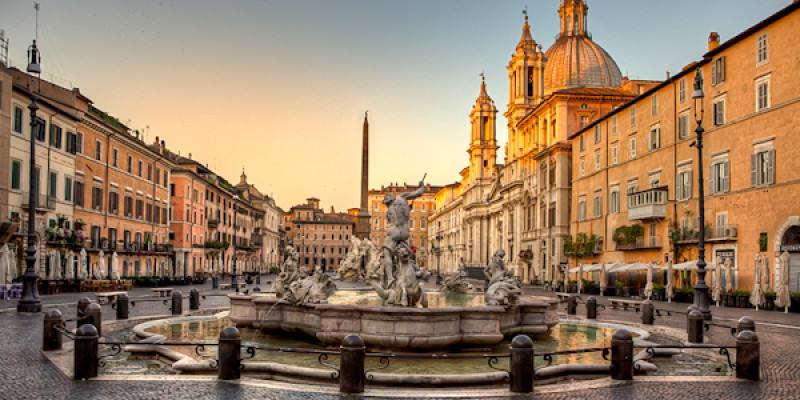
Piazza Navona
Piazza Navona (pronounced [ˈpjattsa naˈvoːna]) is a square in Rome, Italy. It is built on the site of the Stadium of Domitian, built in the 1st century AD, and follows the form of the open space of the stadium. The ancient Romans went there to watch the agones ("games"), and hence it was known as "Circus Agonalis" ("competition arena"). It is believed that over time the name changed to in avone to navone and eventually to navona.
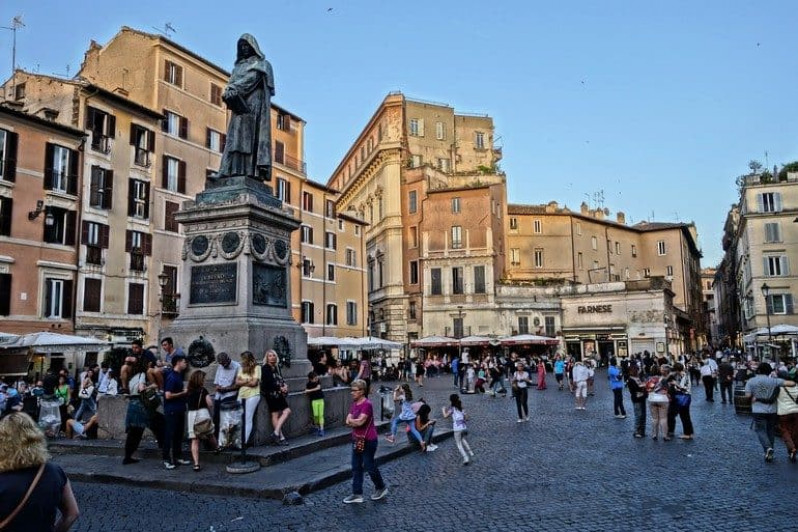
Campo de' Fiori
Campo de' Fiori (Italian: [ˈkampo de ˈfjoːri], literally "field of flowers") is a rectangular square south of Piazza Navona in Rome, Italy, at the border between rione Parione and rione Regola. It is diagonally southeast of the Palazzo della Cancelleria and one block northeast of the Palazzo Farnese. Campo de' Fiori, translated literally from Italian, means "field of flowers". The name dates to the Middle Ages when the area was a meadow.
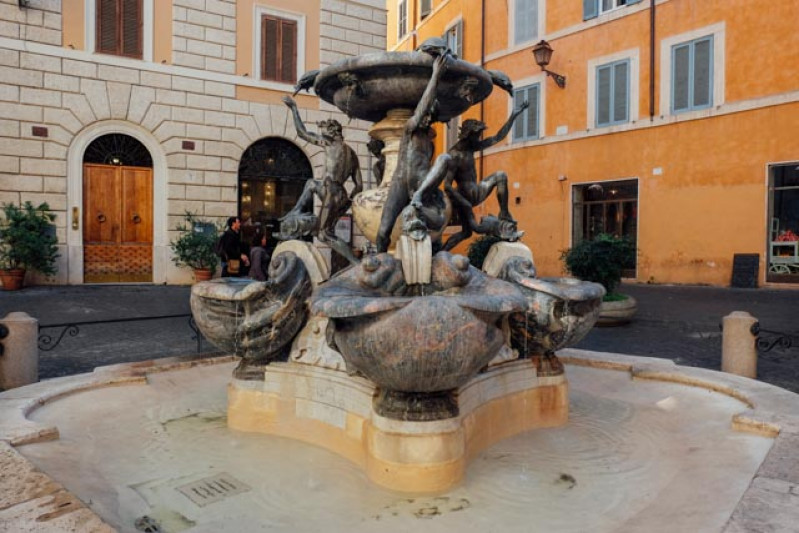
Turtle Fountain
The Fontana delle Tartarughe (The Turtle Fountain) is a fountain of the late Italian Renaissance, located in Piazza Mattei, in the Sant'Angelo district of Rome, Italy. It was built between 1580 and 1588 by the architect Giacomo della Porta and the sculptor Taddeo Landini. The bronze turtles around the upper basin, usually attributed either to Gian Lorenzo Bernini or Andrea Sacchi, were added in either 1658 or 1659 when the fountain was restored.
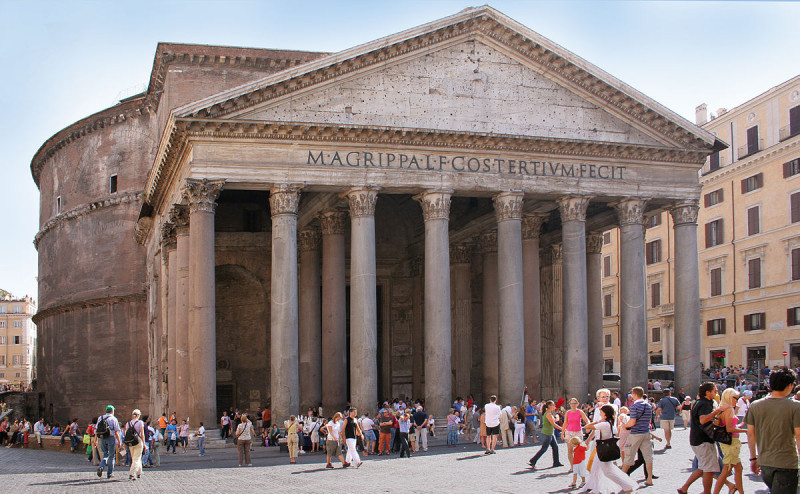
Pantheon
The Pantheon ( or US: ; Latin: Pantheon, from Greek Πάνθειον Pantheion meaning "[temple] of every god") is a former Roman temple, now a church, in Rome, Italy, on the site of an earlier temple commissioned by Marcus Agrippa during the reign of Augustus (27 BC – 14 AD). The present building was completed by the emperor Hadrian and probably dedicated about 126 AD. He retained Agrippa's original inscription, which has confused its date of construction as the original Pantheon burnt down so it is not certain when the present one was built. The building is circular with a portico of large granite Corinthian columns (eight in the first rank and two groups of four behind) under a pediment. A rectangular vestibule links the porch to the rotunda, which is under a coffered concrete dome, with a central opening (oculus) to the sky. Almost two thousand years after it was built, the Pantheon's dome is still the world's largest unreinforced concrete dome. The height to the oculus and the diameter of the interior circle are the same, 142 feet (43 m). It is one of the best-preserved of all Ancient Roman buildings, in large part because it has been in continuous use throughout its history, and since the 7th century, the Pantheon has been used as a church dedicated to "St. Mary and the Martyrs" (Latin: Sancta Maria ad Martyres) but informally known as "Santa Maria Rotonda". The square in front of the Pantheon is called Piazza della Rotonda. The Pantheon is a state property, ruled by Italy's Ministry of Cultural Heritage and Activities and Tourism through the Polo Museale del Lazio; in 2013 it was visited by over 6 million people. The Pantheon's large circular domed cella, with a conventional temple portico front, was unique in Roman architecture. Nevertheless, it became a standard exemplar when classical styles were revived, and has been copied many times by later architects.
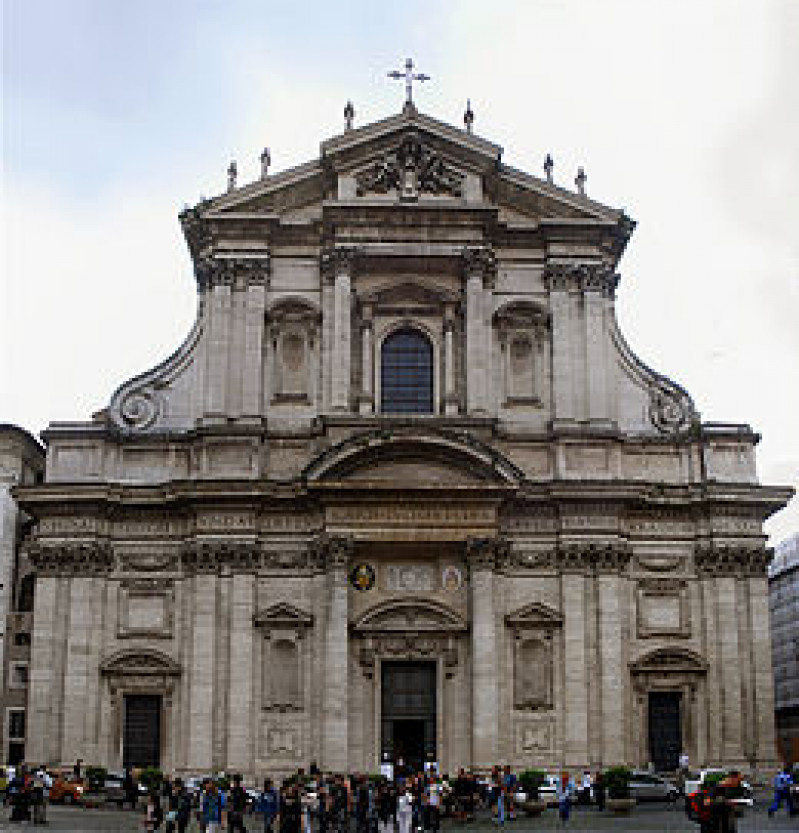
Chiesa di Sant' Ignazio di Loyola
The Church of St. Ignatius of Loyola at Campus Martius (Italian: Chiesa di Sant'Ignazio di Loyola in Campo Marzio, Latin: Ecclesia Santi Ignatii a Loyola in Campo Martio) is a Roman Catholic titular church, of deaconry rank, dedicated to Ignatius of Loyola, the founder of the Society of Jesus, located in Rome, Italy. Built in Baroque style between 1626 and 1650, the church functioned originally as the chapel of the adjacent Roman College, that moved in 1584 to a new larger building and was renamed the Pontifical Gregorian University. The most recent Cardinal of the Titulus S. Ignatii de Loyola in Campo Martio was Cardinal Roberto Tucci, S.J.; he had been its Cardinal Deacon until he became its Cardinal Priest (i.e., opted for the order of cardinal priests, with this church being elevated "pro hac vice" to title).
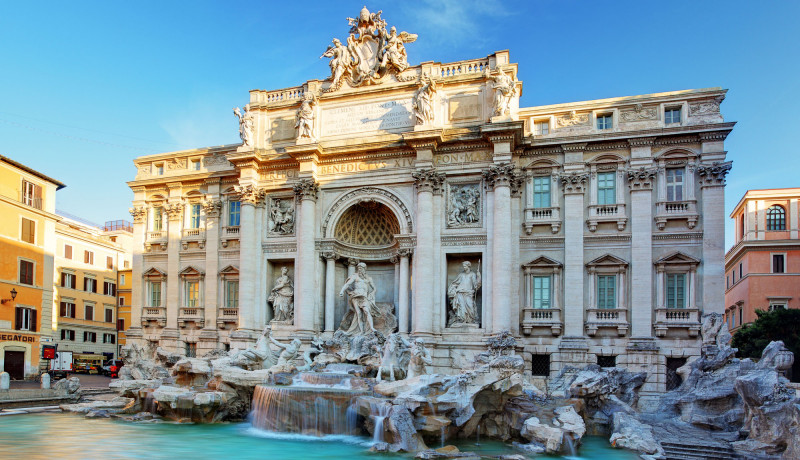
Trevi Fountain
The Trevi Fountain (Italian: Fontana di Trevi) is a fountain in the Trevi district in Rome, Italy, designed by Italian architect Nicola Salvi and completed by Pietro Bracci. Standing 26.3 metres (86 ft) high and 49.15 metres (161.3 ft) wide, it is the largest Baroque fountain in the city and one of the most famous fountains in the world. The fountain has appeared in several notable films, including Federico Fellini's La Dolce Vita, the eponymous Three Coins in the Fountain, and The Lizzie McGuire Movie.
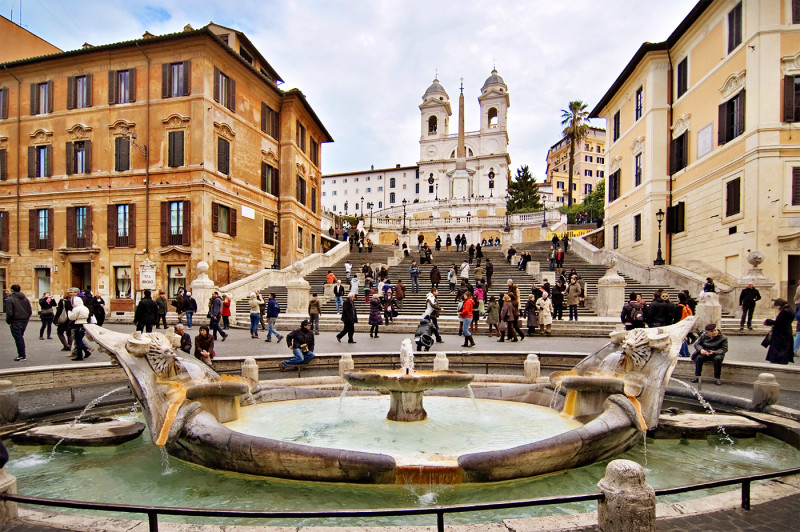
Piazza di Spagna
Piazza di Spagna, at the bottom of the Spanish Steps, is one of the most famous squares in Rome (Italy). It owes its name to the Palazzo di Spagna, seat of the Embassy of Spain among the Holy See. Nearby is the famed Column of the Immaculate Conception of the Blessed Virgin Mary.
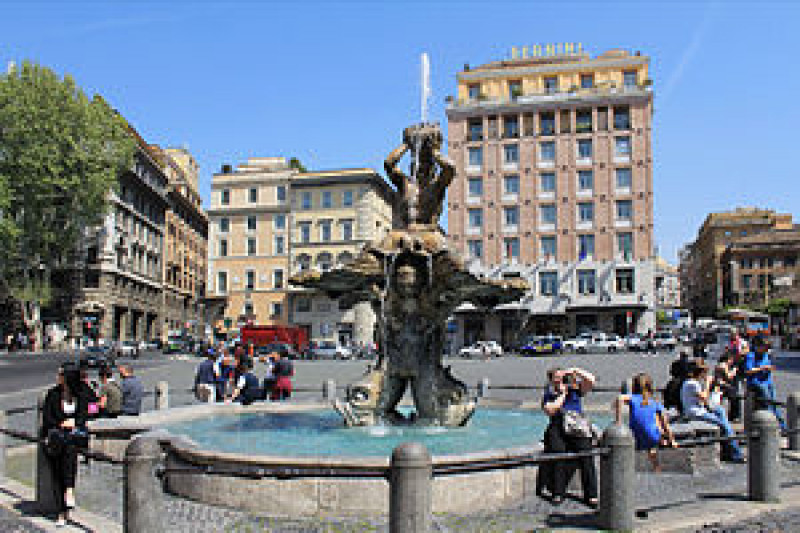
Piazza Barberini
Piazza Barberini is a large piazza in the centro storico or city center of Rome, Italy and situated on the Quirinal Hill. It was created in the 16th century but many of the surrounding buildings have subsequently been rebuilt. The current appellation was given in 1625 when it was named after the Palazzo Barberini, the substantial Baroque palace built in an elevated position on the south side of the piazza for the Barberini. Originally, there was a large entrance gateway to the palace designed by the Baroque painter and architect Pietro da Cortona on the south east corner of the piazza but this was demolished to make way for the construction of a new road in the 19th century. However, its appearance is known from engravings and early photographs of the piazza. At the centre of the piazza is the Fontana del Tritone or Triton Fountain (1642–3) sculpted by Bernini. Another fountain, the Fontana delle Api (1627–1629), also by Bernini is in the nearby Via Vittorio Veneto but it has been reconstructed somewhat arbitrarily following its removal from its previous position on the corner of a palace where the Piazza Barberini meets the Via Sistina. Until the 18th century, unknown human corpses were displayed here for public identification. Between 1632 and 1822 an antique obelisk stood here; it was transferred to Villa Medici.
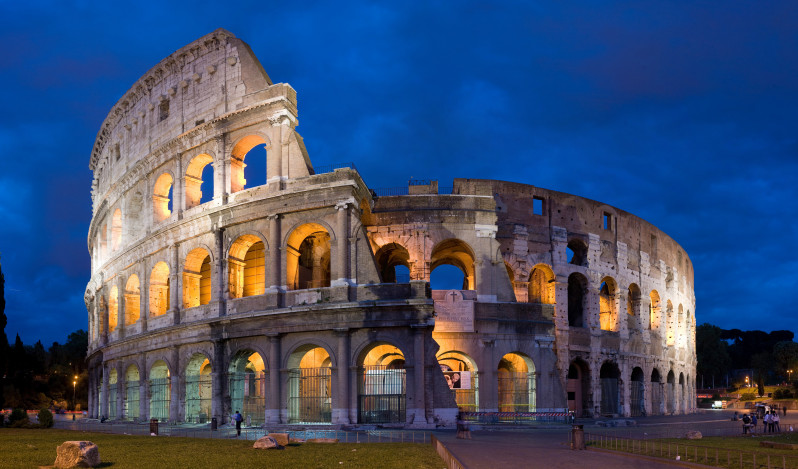
Colosseum
The Colosseum or Coliseum ( kol-ə-SEE-əm), also known as the Flavian Amphitheatre (Latin: Amphitheatrum Flavium; Italian: Anfiteatro Flavio [aŋfiteˈaːtro ˈflaːvjo] or Colosseo [kolosˈsɛːo]), is an oval amphitheatre in the centre of the city of Rome, Italy. Built of travertine, tuff, and brick-faced concrete, it is the largest amphitheatre ever built. The Colosseum is situated just east of the Roman Forum. Construction began under the emperor Vespasian in AD 72, and was completed in AD 80 under his successor and heir Titus. Further modifications were made during the reign of Domitian (81–96). These three emperors are known as the Flavian dynasty, and the amphitheatre was named in Latin for its association with their family name (Flavius). The Colosseum could hold, it is estimated, between 50,000 and 80,000 spectators, having an average audience of some 65,000; it was used for gladiatorial contests and public spectacles such as mock sea battles (for only a short time as the hypogeum was soon filled in with mechanisms to support the other activities), animal hunts, executions, re-enactments of famous battles, and dramas based on Classical mythology. The building ceased to be used for entertainment in the early medieval era. It was later reused for such purposes as housing, workshops, quarters for a religious order, a fortress, a quarry, and a Christian shrine. Although partially ruined because of damage caused by earthquakes and stone-robbers, the Colosseum is still an iconic symbol of Imperial Rome. It is one of Rome's most popular tourist attractions and also has links to the Roman Catholic Church, as each Good Friday the Pope leads a torchlit "Way of the Cross" procession that starts in the area around the Colosseum. The Colosseum is also depicted on the Italian version of the five-cent euro coin. The Colosseum's original Latin name was Amphitheatrum Flavium, often anglicized as Flavian Amphitheatre. The building was constructed by emperors of the Flavian dynasty, following the reign of Nero. This name is still used in modern English, but generally the structure is better known as the Colosseum. In antiquity, Romans may have referred to the Colosseum by the unofficial name Amphitheatrum Caesareum (with Caesareum an adjective pertaining to the title Caesar), but this name may have been strictly poetic as it was not exclusive to the Colosseum; Vespasian and Titus, builders of the Colosseum, also constructed an amphitheater of the same name in Puteoli (modern Pozzuoli). The name Colosseum has long been believed to be derived from a colossal statue of Nero nearby (the statue of Nero was named after the Colossus of Rhodes). This statue was later remodeled by Nero's successors into the likeness of Helios (Sol) or Apollo, the sun god, by adding the appropriate solar crown. Nero's head was also replaced several times with the heads of succeeding emperors. Despite its pagan links, the statue remained standing well into the medieval era and was credited with magical powers. It came to be seen as an iconic symbol of the permanence of Rome. In the 8th century, a famous epigram attributed to the Venerable Bede celebrated the symbolic significance of the statue in a prophecy that is variously quoted: Quamdiu stat Colisæus, stat et Roma; quando cadet colisæus, cadet et Roma; quando cadet Roma, cadet et mundus ("as long as the Colossus stands, so shall Rome; when the Colossus falls, Rome shall fall; when Rome falls, so falls the world"). This is often mistranslated to refer to the Colosseum rather than the Colossus (as in, for instance, Byron's poem Childe Harold's Pilgrimage). However, at the time that the Pseudo-Bede wrote, the masculine noun coliseus was applied to the statue rather than to what was still known as the Flavian amphitheatre. The Colossus did eventually fall, possibly being pulled down to reuse its bronze. By the year 1000 the name "Colosseum" had been coined to refer to the amphitheatre. The statue itself was largely forgotten and only its base survives, situated between the Colosseum and the nearby Temple of Venus and Roma. The name further evolved to Coliseum during the Middle Ages. In Italy, the amphitheatre is still known as il Colosseo, and other Romance languages have come to use similar forms such as Coloseumul (Romanian), le Colisée (French), el Coliseo (Spanish) and o Coliseu (Portuguese).
Share on Pinterest
