- Pražský hrad
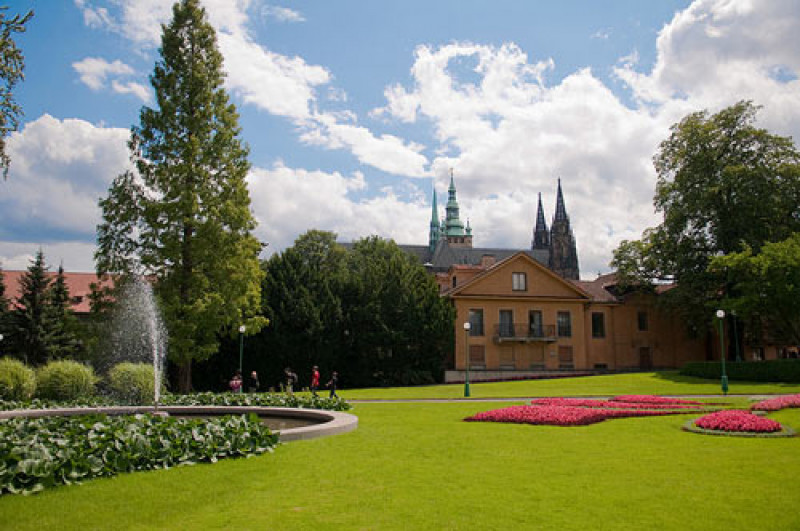
- Royal Garden
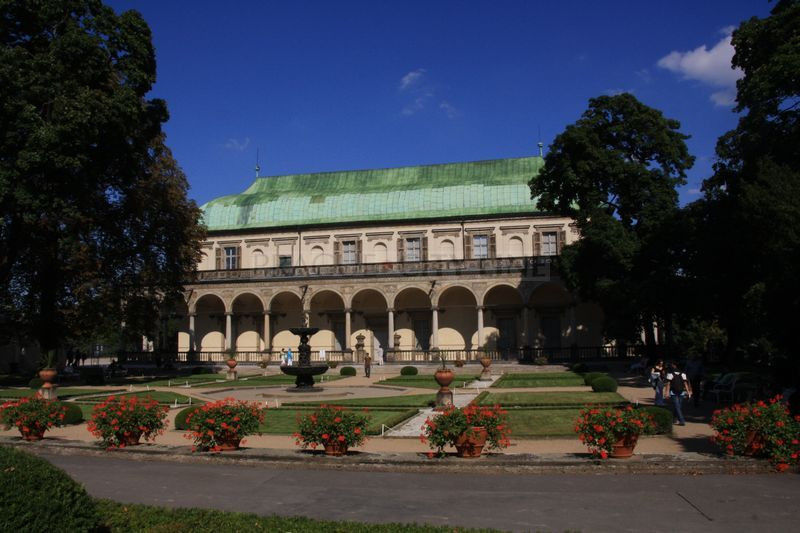
- Royal Summer Palace
- Daliborka Tower
- Lobkowicz Palace
- Zlatá ulička u Daliborky
- St. George's Basilica
- Old Royal Palace
- Fountain and statue of Saint George, Prague Castle
- Matthias Gate
- Hradcany Square
- Lobkowitz Palace
- Vrtba Garden
- Church of Our Lady Victorious and The Infant Jesus of Prague
- Hellichova (Tram stop)
- Museum Kampa
- Lesser Town Bridge Tower
- Cukr Káva Limonáda
- Malostranské náměstí
- Wallenstein Garden
- Narrowest Street in Prague
- Charles Bridge
- Old Town Bridge Tower
- Dancing House
- Green Garden Hotel
- 25 sights
- 2 h 09 min
- 10.80 km / 6.71 mi
Prága 2. nap
2. Nap: Prágai vár és Kisoldal
1) Vár
2) Királyi kert
3) Nyári palota
4) Daliborka torony
5) Lobkovicz palota
6) Arany utcácska
7) Szent György bazilika
8) Régi palota
9) Szent György szobor
10) Mátyás kapu
11) Hradcany tér
12) Másik Lobkowicz palota
13) Vrtba kert
14) Győzedelmes boldogasszony temploma (kb vele szemben van egy hangszermúzeum is)
15) Hellichova villamosmegálló (ez csak azért, hogy jól jöjjön ki az útvonal)
16) Kampa sziget
17) Károlyhíd vége az őrtoronnyal
18) John Lennon fal
19) Kisvárosi tér - térnél a Szent Miklós templom
20) Wallenstein kert
21) Prága legkeskenyebb utcája
22) Károly híd
21) Károly híd másik parton lévő tornya
22) Séta vissza le a folyó mentén
23) Táncoló ház

Anonymous user
published 2 years ago
Sights

Pražský hrad
Royal Garden
Royal Garden is the largest residential building in height of Brazil, at 140 metres and 42 floors, according to List of skyscrapers in Brazil. Created in 1988, it's the tallest in the state of Paraná. Designed originally to be the largest in Latin America, this was prevented by the municipal government of the time since its construction during a fire in the 32nd floor was fought with great difficulty due to its height. After this happened, construction of buildings with more than 30 floors in the city was prohibited. The Royal Garden is located at Avenida Tiradentes in Maringá, Paraná, the building has an apartment per floor, valued around 1,5 million of U.S. dollars each.
Royal Summer Palace
Daliborka Tower
Lobkowicz Palace
Zlatá ulička u Daliborky
St. George's Basilica
Old Royal Palace
Fountain and statue of Saint George, Prague Castle
Matthias Gate
Hradcany Square
Lobkowitz Palace
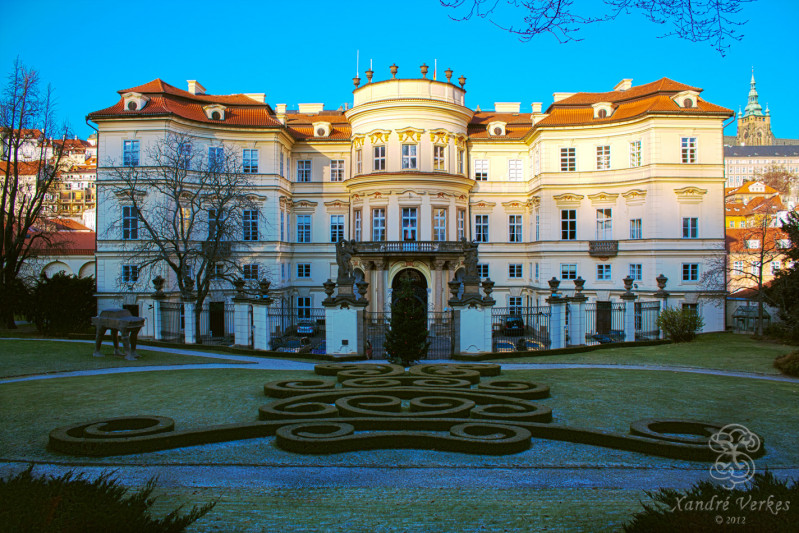
The Lobkowicz Palace is a part of the Prague Castle complex in Prague, Czech Republic. It is the only privately owned building in the Prague Castle complex and houses the Lobkowicz Collections and Museum. The palace was built in the second half of the 16th century by the Czech nobleman Jaroslav of Pernštejn and completed by his brother, Vratislav of Pernštejn , the chancellor of the Czech Kingdom. It was opened to the public for the first time on 2 April 2007 as the Lobkowicz Palace Museum. Set in 22 galleries, the museum displays a selection of pieces from the Lobkowicz Collections, including works by artists such as Antonio Canaletto, Pieter Brueghel the Elder, Lucas Cranach the Elder, and Diego Velázquez, as well as decorative art, military and hunting paraphernalia, musical instruments, and original manuscripts and early prints of composers including Beethoven and Mozart.
Vrtba Garden
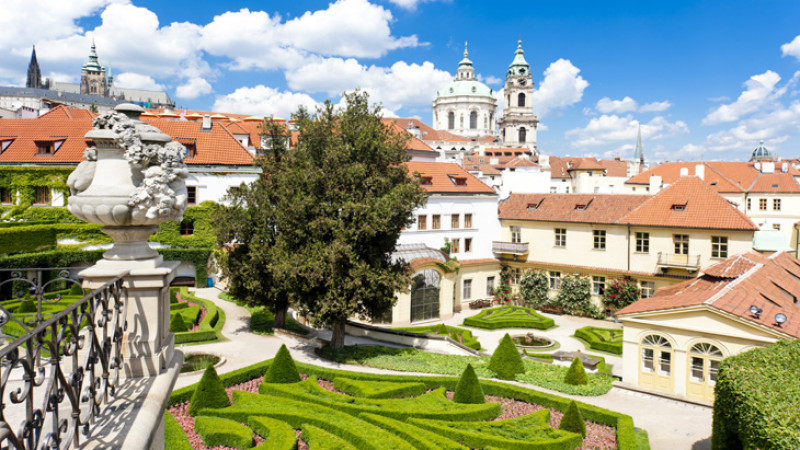
The Vrtba Garden (Czech: Vrtbovská zahrada) in Prague is one of several fine High Baroque gardens in the Czech capital. Like three other Baroque gardens (the Vratislav, Schönborn and Lobkowicz palace gardens) the Vrtba Garden is situated on the slope of Petřín Hill in the Malá Strana section of the city. In the midst of an expansive moment in Prague's history during the 1710s and 1720s, the garden was laid out by František Maxmilián Kaňka, who was renovating the Vrtba palace for Jan Josef, Count of Vrtba. Though the palace has undergone extensive reconstructions in the succeeding centuries, the garden retained its Baroque style and the original statuary and sculptural decor by Matyáš Bernard Braun. In addition, the fresco interiors of the Sala Terrena that links palace and gardem, executed by Václav Vavřinec Reiner have also survived. Facing the Sala Terrena across a central pool is a matching former aviary. Between 1990 and 1998 the Vrtba garden underwent structural conservation and extensive replanting and was reopened for public in June 1998. The formal clipped garden in the French taste laid out in clipped scrolling asymmetrical broderies of boxwood in gravel on three terraced levels makes use of an irregular steep slope more characteristic of Italian garden sites, in a cramped space that was already densely built over when the garden was established. It is listed for its historic cultural values by UNESCO. Today the garden is entered from the base, through a discreet gate in Karmelitská Street. It is often used as a venue for weddings, receptions and other celebrations.
Church of Our Lady Victorious and The Infant Jesus of Prague
Hellichova (Tram stop)
Museum Kampa
Lesser Town Bridge Tower
Cukr Káva Limonáda
Malostranské náměstí
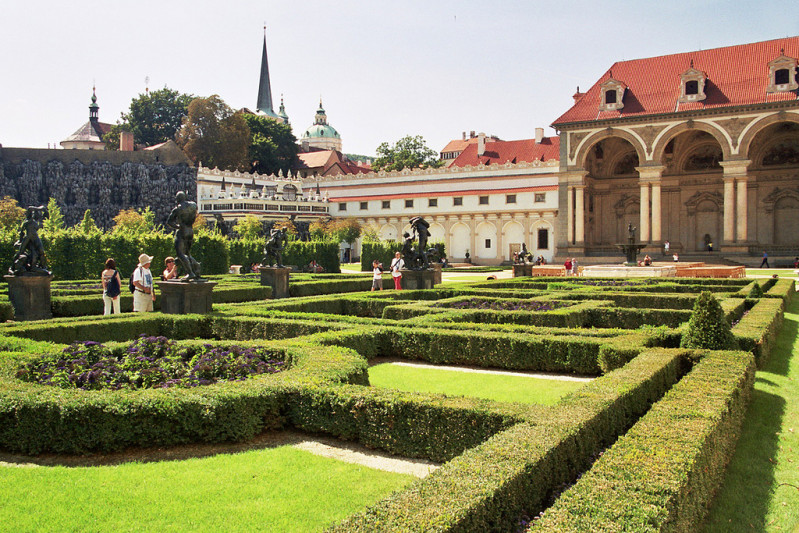
Wallenstein Garden
Wallenstein Palace (Czech: Valdštejnský palác) is a Baroque palace in Malá Strana, Prague, that served as a residence for Imperial Generalissimo Albrecht von Wallenstein and now houses the Senate of the Czech Republic.
Narrowest Street in Prague
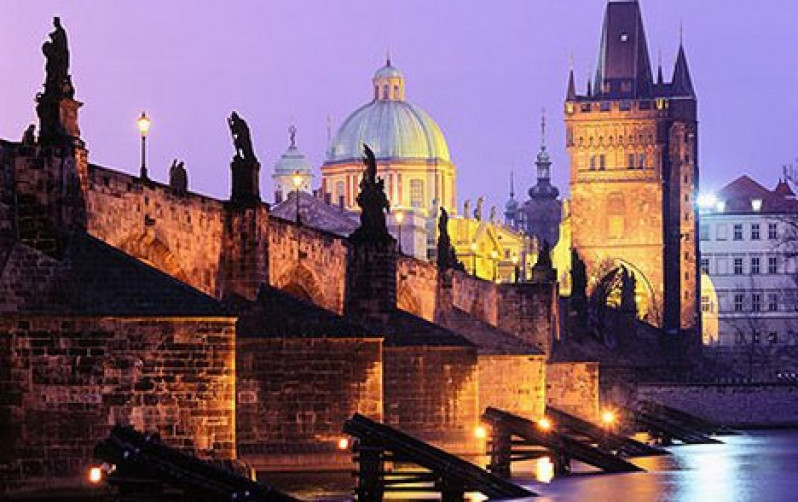
Charles Bridge
Charles Bridge (Czech: Karlův most [ˈkarluːf ˈmost] ( listen)) is a historic bridge that crosses the Vltava river in Prague, Czech Republic. Its construction started in 1357 under the auspices of King Charles IV, and finished in the beginning of the 15th century. The bridge replaced the old Judith Bridge built 1158–1172 that had been badly damaged by a flood in 1342. This new bridge was originally called Stone Bridge (Kamenný most) or Prague Bridge (Pražský most) but has been "Charles Bridge" since 1870. As the only means of crossing the river Vltava (Moldau) until 1841, Charles Bridge was the most important connection between Prague Castle and the city's Old Town and adjacent areas. This "solid-land" connection made Prague important as a trade route between Eastern and Western Europe. The bridge is 621 metres (2,037 ft) long and nearly 10 metres (33 ft) wide, following the example of the Stone Bridge in Regensburg, it was built as a bow bridge with 16 arches shielded by ice guards. It is protected by three bridge towers, two of them on the Lesser Quarter side and the third one on the Old Town side. The Old Town Bridge Tower is often considered to be one of the most astonishing civil gothic-style buildings in the world. The bridge is decorated by a continuous alley of 30 statues and statuaries, most of them baroque-style, originally erected around 1700 but now all replaced by replicas. Repairs are scheduled to start in late 2019, they should take around 20 years.
Old Town Bridge Tower
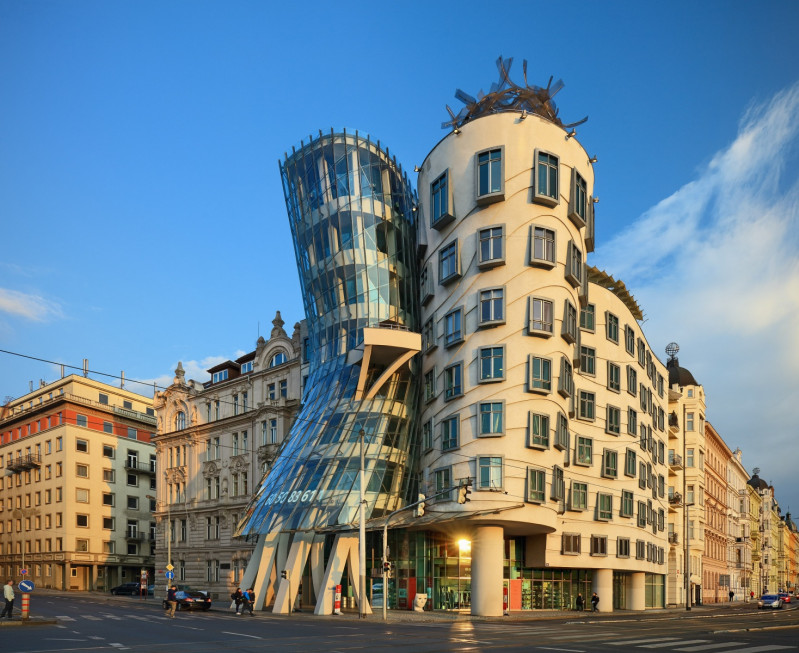
Dancing House
The Dancing House (Czech: Tančící dům), or Fred and Ginger, is the nickname given to the Nationale-Nederlanden building on the Rašínovo nábřeží (Rašín Embankment) in Prague, Czech Republic. It was designed by the Croatian-Czech architect Vlado Milunić in cooperation with Canadian-American architect Frank Gehry on a vacant riverfront plot. The building was designed in 1992 and completed in 1996. The very non-traditional design was controversial at the time because the house stands out among the Baroque, Gothic and Art Nouveau buildings for which Prague is famous, and in the opinion of some it does not accord well with these architectural styles. The then Czech president, Václav Havel, who lived for decades next to the site, had avidly supported this project, hoping that the building would become a center of cultural activity. Gehry originally named the house Fred and Ginger (after the famous dancers Fred Astaire and Ginger Rogers – the house resembles a pair of dancers) but this nickname is now rarely used; moreover, Gehry himself was later "afraid to import American Hollywood kitsch to Prague", and thus discarded his own idea.
Green Garden Hotel
Share on Pinterest
