- 6 sights
- 0 h 28 min
- 2.34 km / 1.45 mi
Rome routines
the journey begins in Piazza del Popolo. go along in via del babuino to get to piazza di spagna. go along into via di spagna and turn right twice go along into via dei due macelli and turn left taking via di capo le case turn left and go along into via di santandrea delle fratte turn right into via del bufalo turn to right and go to via poti and go along to the trevi fountain go along to via delle marotte to the stone square go along to via dei pastivi and you arrive on the pantheon

Anonymous user
published 2 years ago
Sights
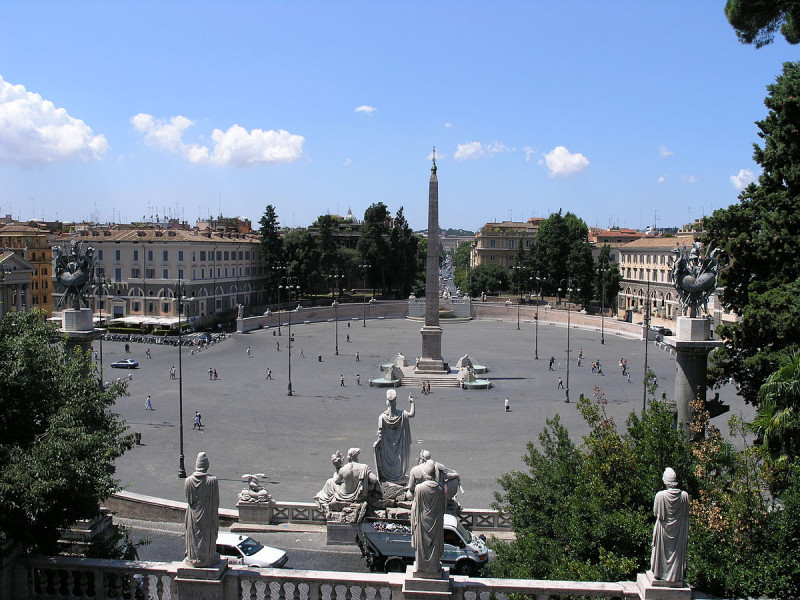
Piazza del Popolo
Piazza del Popolo is a large urban square in Rome. The name in modern Italian literally means "People's Square", but historically it derives from the poplars (populus in Latin, pioppo in Italian) after which the church of Santa Maria del Popolo, in the northeast corner of the piazza, takes its name. The piazza lies inside the northern gate in the Aurelian Walls, once the Porta Flaminia of ancient Rome, and now called the Porta del Popolo. This was the starting point of the Via Flaminia, the road to Ariminum (modern-day Rimini) and the most important route to the north. At the same time, before the age of railroads, it was the traveller's first view of Rome upon arrival. For centuries, the Piazza del Popolo was a place for public executions, the last of which took place in 1826.
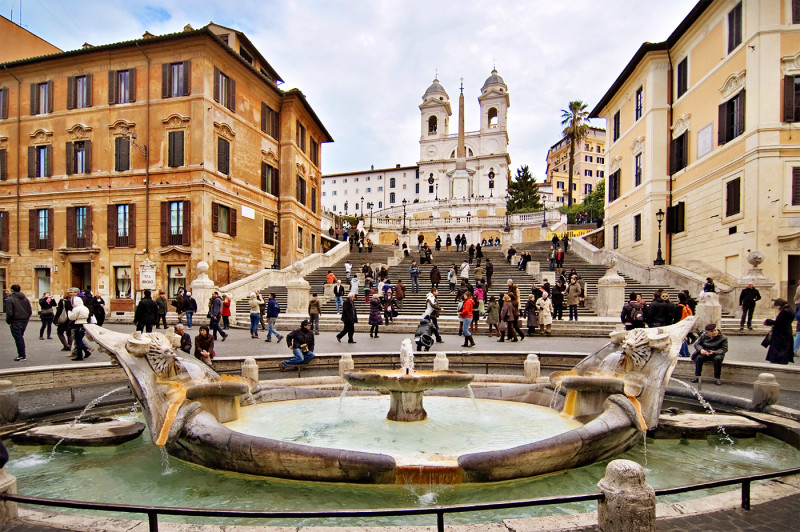
Piazza di Spagna
Piazza di Spagna, at the bottom of the Spanish Steps, is one of the most famous squares in Rome (Italy). It owes its name to the Palazzo di Spagna, seat of the Embassy of Spain among the Holy See. Nearby is the famed Column of the Immaculate Conception of the Blessed Virgin Mary.

Sant'Andrea delle Fratte
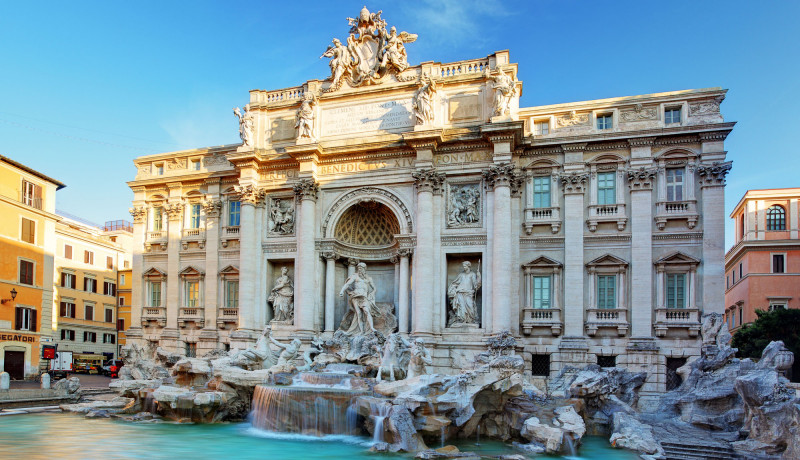
Trevi Fountain
The Trevi Fountain (Italian: Fontana di Trevi) is a fountain in the Trevi district in Rome, Italy, designed by Italian architect Nicola Salvi and completed by Pietro Bracci. Standing 26.3 metres (86 ft) high and 49.15 metres (161.3 ft) wide, it is the largest Baroque fountain in the city and one of the most famous fountains in the world. The fountain has appeared in several notable films, including Federico Fellini's La Dolce Vita, the eponymous Three Coins in the Fountain, and The Lizzie McGuire Movie.
Piazza di Pietra
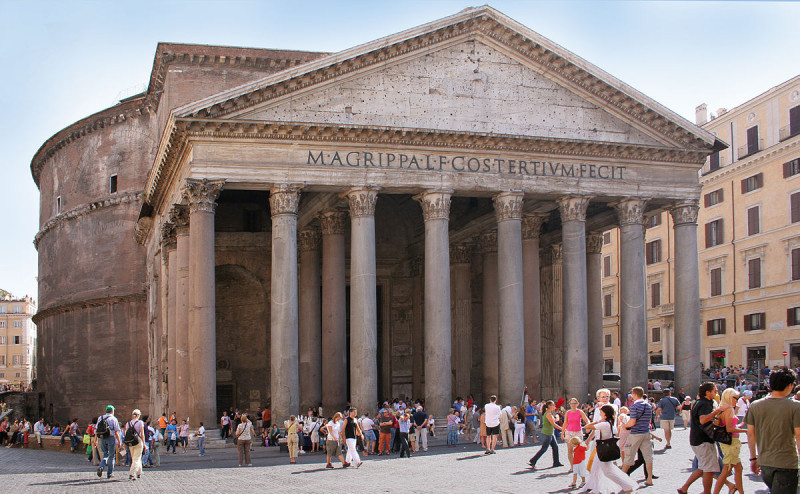
Pantheon
The Pantheon ( or US: ; Latin: Pantheon, from Greek Πάνθειον Pantheion meaning "[temple] of every god") is a former Roman temple, now a church, in Rome, Italy, on the site of an earlier temple commissioned by Marcus Agrippa during the reign of Augustus (27 BC – 14 AD). The present building was completed by the emperor Hadrian and probably dedicated about 126 AD. He retained Agrippa's original inscription, which has confused its date of construction as the original Pantheon burnt down so it is not certain when the present one was built. The building is circular with a portico of large granite Corinthian columns (eight in the first rank and two groups of four behind) under a pediment. A rectangular vestibule links the porch to the rotunda, which is under a coffered concrete dome, with a central opening (oculus) to the sky. Almost two thousand years after it was built, the Pantheon's dome is still the world's largest unreinforced concrete dome. The height to the oculus and the diameter of the interior circle are the same, 142 feet (43 m). It is one of the best-preserved of all Ancient Roman buildings, in large part because it has been in continuous use throughout its history, and since the 7th century, the Pantheon has been used as a church dedicated to "St. Mary and the Martyrs" (Latin: Sancta Maria ad Martyres) but informally known as "Santa Maria Rotonda". The square in front of the Pantheon is called Piazza della Rotonda. The Pantheon is a state property, ruled by Italy's Ministry of Cultural Heritage and Activities and Tourism through the Polo Museale del Lazio; in 2013 it was visited by over 6 million people. The Pantheon's large circular domed cella, with a conventional temple portico front, was unique in Roman architecture. Nevertheless, it became a standard exemplar when classical styles were revived, and has been copied many times by later architects.
Share on Pinterest
