- 5 sights
- 0 h 41 min
- 3.48 km / 2.16 mi

Sights
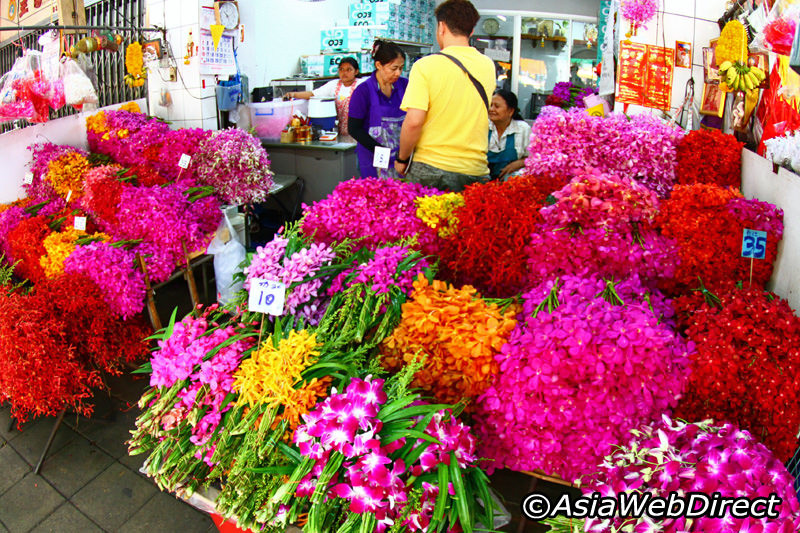
Flower Market
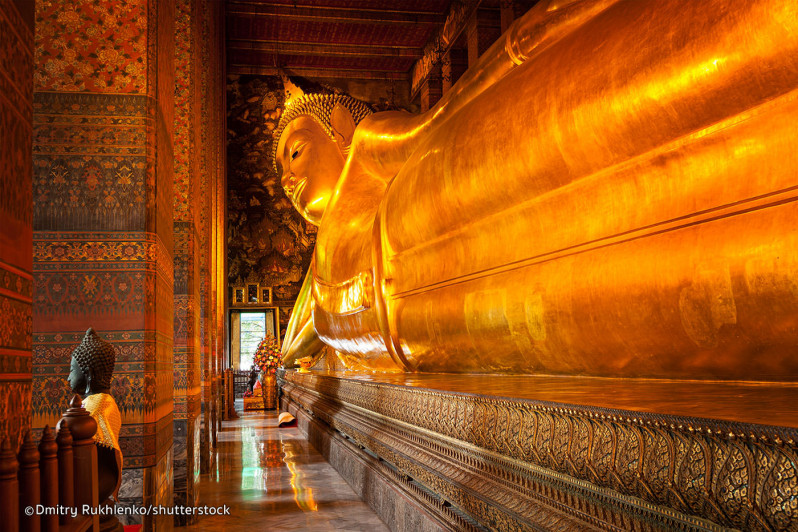
Wat Pho
Wat Pho (Thai: วัดโพธิ์, IPA: [wát pʰoː]), also spelt Wat Po, is a Buddhist temple complex in the Phra Nakhon District, Bangkok, Thailand. It is on Rattanakosin Island, directly south of the Grand Palace. Known also as the Temple of the Reclining Buddha, its official name is Wat Phra Chetuphon Vimolmangklararm Rajwaramahaviharn (Thai: วัดพระเชตุพนวิมลมังคลารามราชวรมหาวิหาร; RTGS: Wat Phra Chettuphon Wimonmangkhlaram Ratchaworamahawihan; IPA: [wát pʰráʔ tɕʰê:t.tù.pʰon wíʔ.mon.maŋ.kʰlaː.raːm râːt.tɕʰá.wɔː.ráʔ.má.hǎː.wíʔ.hǎːn]). The more commonly known name, Wat Pho, is a contraction of its older name Wat Photaram (Thai: วัดโพธาราม; RTGS: Wat Photharam). The temple is first on the list of six temples in Thailand classed as the highest grade of the first-class royal temples. It is associated with King Rama I who rebuilt the temple complex on an earlier temple site, and became his main temple where some of his ashes are enshrined. The temple was later expanded and extensively renovated by Rama III. The temple complex houses the largest collection of Buddha images in Thailand, including a 46 m long reclining Buddha. The temple is considered the earliest centre for public education in Thailand, and the marble illustrations and inscriptions placed in the temple for public instructions has been recognised by UNESCO in its Memory of the World Programme. It houses a school of Thai medicine, and is also known as the birthplace of traditional Thai massage which is still taught and practiced at the temple.
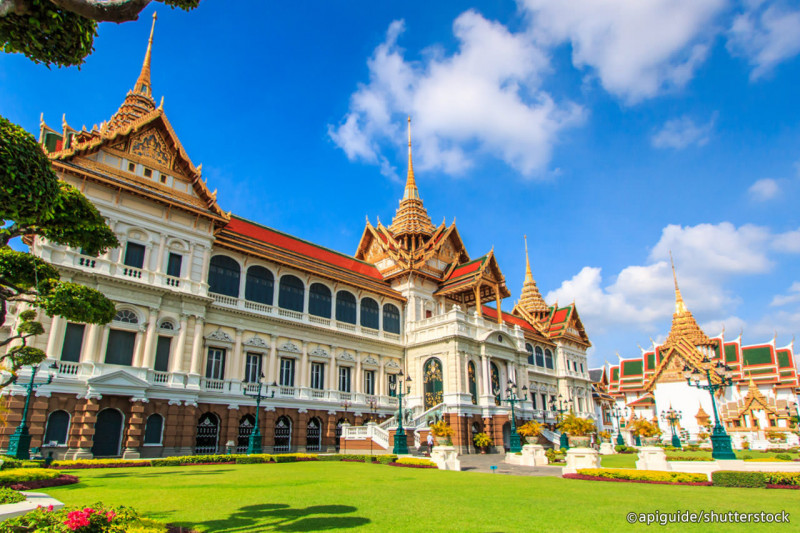
Grand Royal Palace
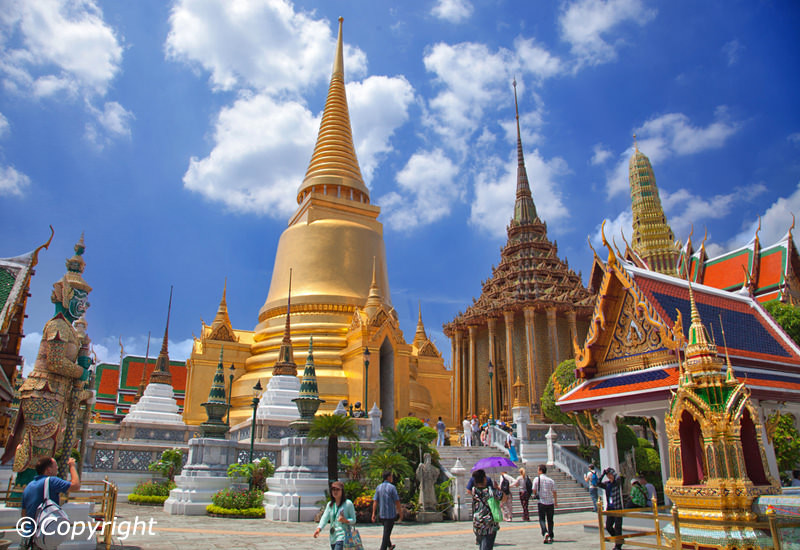
Wat Phra Kaeo
Wat Phra Kaew, commonly known in English as the Temple of the Emerald Buddha and officially as Wat Phra Si Rattana Satsadaram, is regarded as the most sacred Buddhist temple (wat) in Thailand. The Emerald Buddha housed in the temple is a potent religio-political symbol and the palladium (protective image) of Thai society. It is located in Phra Nakhon District, the historic centre of Bangkok, within the precincts of the Grand Palace. The main building is the central phra ubosot, which houses the statue of the Emerald Buddha. According to legend, this Buddha image originated in India where the sage Nagasena prophesized that the Emerald Buddha would bring "prosperity and pre-eminence to each country in which it resides", the Emerald Buddha deified in the Wat Phra Kaew is therefore deeply revered and venerated in Thailand as the protector of the country. Historical records however dates its finding to Chiang Rai in the 15th century where, after it was relocated a number of times, it was finally taken to Thailand in the 18th century. It was enshrined in Bangkok at the Wat Phra Kaew temple in 1782 during the reign of Phutthayotfa Chulalok, King Rama I (1782–1809). This marked the beginning of the Chakri Dynasty of Thailand, whose current sovereign is Vajiralongkorn, King Rama X. The Emerald Buddha, a dark green statue, is in a standing form, about 66 centimetres (26 in) tall, carved from a single jade stone ("emerald" in Thai means deep green colour and not the specific stone). It is carved in the meditating posture in the style of the Lanna school of the northern Thailand. Except for the Thai King and, in his stead, the Crown Prince, no other persons are allowed to touch the statue. The King changes the cloak around the statue three times a year, corresponding to the summer, winter, and rainy seasons, an important ritual performed to usher good fortune to the country during each season.
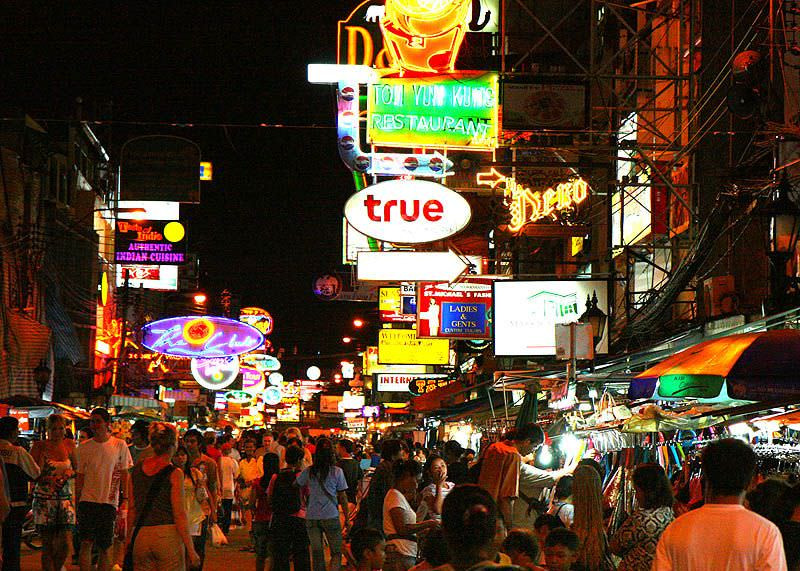
Khaosan Road
Khaosan Road or Khao San Road (Thai: ถนนข้าวสาร) is a short (410 meter long) street in central Bangkok, Thailand constructed in 1892 during the reign of Rama V. It is in the Banglamphu area of (Phra Nakhon district) about 1 kilometre (0.62 mi) north of the Grand Palace and Wat Phra Kaew. "Khaosan" translates as "milled rice", a reminder that in former times the street was a major Bangkok rice market. In the last 20 years, however, Khaosan Road has developed into a world-famous "backpacker ghetto". It offers cheap accommodation, ranging from "mattress in a box" style hotels to reasonably priced 3-star hotels. In an essay on the backpacker culture of Khaosan Road, Susan Orlean called it "the place to disappear". Despite its reputation a diverse group of travellers can be found on Khao San Road. In this small area one can observe the interactions and groupings of disparate characters such as well-educated young Westerners on extended leave from affluent society, high school graduates on gap year travels, Israelis fresh out of military service, university students on holiday or sabbatical leave, young Japanese in rite-of-passage attire, ordinary holidaymakers, (ex-) volunteers from various organizations, and the like. It is also a base of travel: coaches leave daily for all major tourist destinations in Thailand, from Chiang Mai in the north to Ko Pha Ngan in the south, and there are many relatively inexpensive travel agents who can arrange visas and transportation to the neighbouring countries of Cambodia, Laos, Malaysia, and Vietnam. Khaosan shops sell handicrafts, paintings, clothes, local fruits, unlicensed CDs, DVDs, a wide range of fake IDs, used books, plus many useful backpacker items. During late evening, the streets turn into bars and music is played, food hawkers sell barbecued insects, exotic snacks for tourists, and there are also local people selling ping pong shows. There are several cafes, pubs and bars where backpackers meet to discuss their travels. The area is internationally known as a center of dancing, partying, and just prior to the traditional Thai New Year (Songkran festival) of 13–15 April, water splashing that usually turns into a huge water fight. One Thai writer has described Khaosan as "...a short road that has the longest dream in the world". A Buddhist temple under royal patronage, the centuries-old Wat Chana Songkram, is directly opposite Khaosan Road to the west, while the area to the northwest contains an Islamic community and several small mosques.
Share on Pinterest
